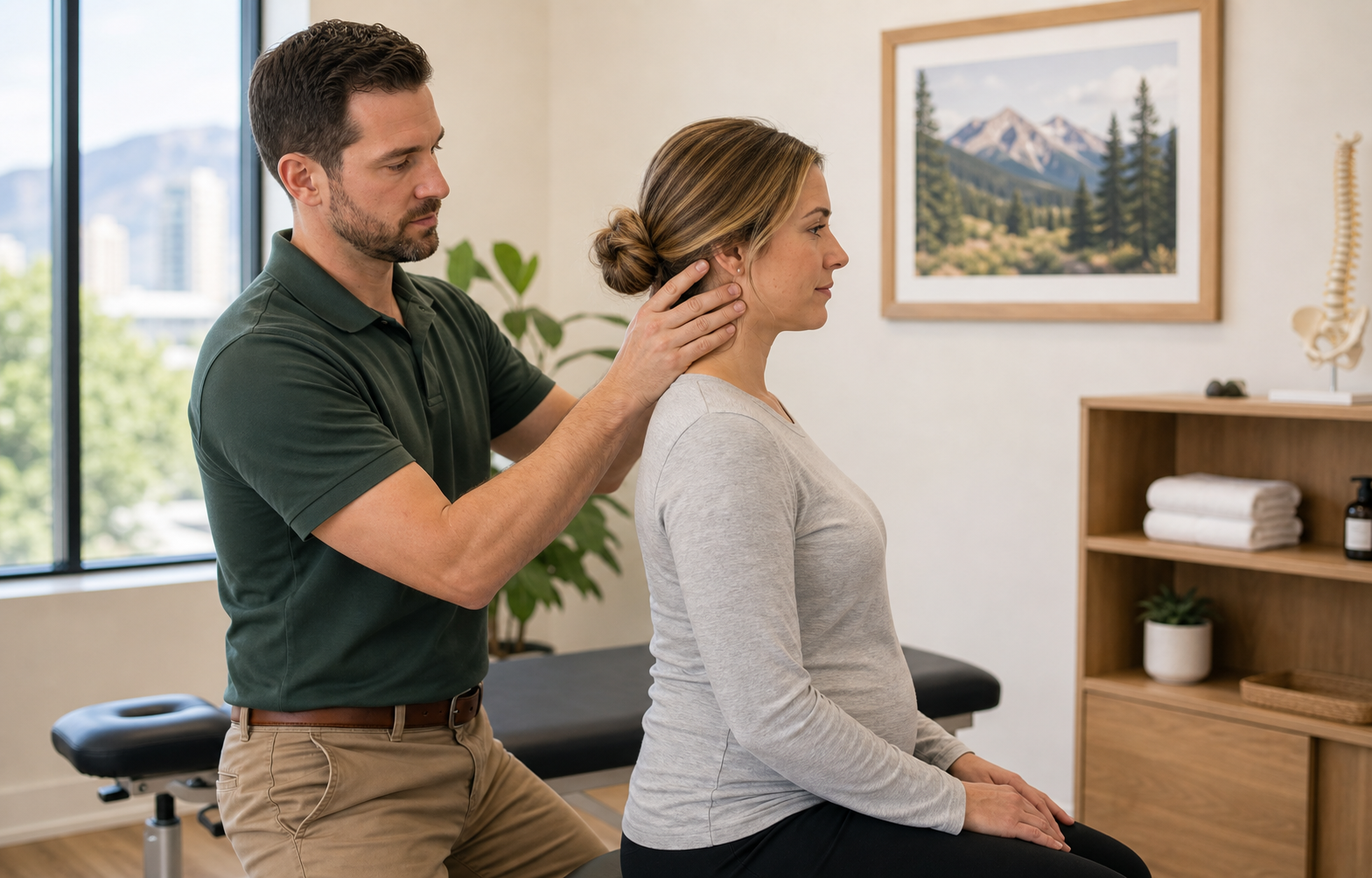
Upper cervical chiropractor in Denver — precision care at the craniocervical junction
The upper cervical spine is one of the most mechanically complex and neurologically significant regions of the body. The atlas (C1) and axis (C2) are the first two vertebrae below the skull. They house and protect the brainstem — the part of the nervous system that coordinates breathing, heart rate, balance, and the integration of sensory signals from the head and face. The atlas alone has no disc and must support the full weight of the skull while allowing its wide range of rotation.
When C1 or C2 is misaligned — whether from trauma, accumulated postural stress, or developmental factors — the consequences can extend well beyond the neck. Headaches that originate at the base of the skull. Dizziness triggered by head movement. TMJ pain and facial tension. Tinnitus. Chronic upper neck stiffness that doesn’t resolve with general treatment. Post-concussion symptoms that linger weeks or months after injury. Denver patients dealing with these patterns often benefit from an evaluation specifically focused on the upper cervical spine. In pain? Call (303) 529-4198 for immediate Denver relief.
Why the upper cervical spine matters differently than the rest of the spine
Most of the lumbar and thoracic spine tolerates misalignment with primarily local effects — local joint pain, local disc pressure, localized nerve irritation. The upper cervical spine is different. C1 and C2 sit at the intersection of the skull, brainstem, and spinal cord. The structures passing through this junction include the vertebral arteries, the upper cervical nerve roots, the spinal cord itself, and the proprioceptive receptors that contribute to balance and spatial orientation.
Misalignment at C1 affects head position. The body compensates for an unlevel head by shifting posture all the way down the spine — altering shoulder height, hip alignment, and even leg loading. This is why patients with upper cervical dysfunction sometimes present with symptoms far from the neck itself.
Denver’s population sees upper cervical problems from several consistent sources: auto accidents on I-25 and I-70 that produce whiplash forces directed specifically at the craniocervical junction; falls from skiing or snowboarding; cycling accidents on Denver’s trails and roads; and cumulative postural stress from the laptop-and-monitor setups of Denver’s tech industry.
Upper cervical conditions treated in Denver
Cervicogenic headaches — Headaches that originate in the cervical spine rather than the brain itself. These typically start at the base of the skull and radiate forward over the top of the head or behind the eyes. Upper cervical care reduces the frequency and intensity of headaches in many patients by addressing the mechanical source rather than masking the symptom.
Migraine patterns — Some migraine triggers and frequency reduction have been associated with upper cervical alignment. Patients with both cervicogenic headaches and migraines may see improvement in both with upper cervical care.
Dizziness and vertigo — Cervicogenic dizziness — dizziness or imbalance related to cervical proprioceptive dysfunction — is distinct from inner ear causes. It typically worsens with head and neck movement and may be accompanied by neck pain or stiffness. Upper cervical care can reduce cervicogenic dizziness significantly.
Post-concussion symptoms — After a concussion, the upper cervical spine often sustains mechanical stress that contributes to prolonged symptoms. Headache, brain fog, light sensitivity, and fatigue that persist beyond the expected recovery period may have a cervical component addressable with upper cervical care.
TMJ and facial pain — The trigeminal nerve — responsible for sensation in the face and jaw — enters the brainstem at the level of the upper cervical spine. Upper cervical dysfunction can contribute to TMJ symptoms, facial pain, and jaw tension.
Tinnitus — Some cases of ringing in the ears have a cervicogenic component. Upper cervical care helps a subset of tinnitus patients, particularly those with associated neck pain or trauma history.
Upper cervical technique: gentle, precise, no cracking
Upper cervical care uses low-force, highly specific techniques that do not involve the rotational thrusting or audible “cracking” associated with general chiropractic adjustments. The correction is delivered with precise contact and minimal force — the goal is to restore atlas alignment without generating the jarring force that many patients find uncomfortable in the upper neck.
Denver patients who have avoided cervical care because of concerns about neck manipulation often find upper cervical techniques acceptable. Call (303) 529-4198 to schedule an upper cervical chiropractic evaluation in Denver.